PULSE: Surprise-Based Online Unsupervised Keyframe Detection

Causal keyframe detection for robot manipulation from complementary visual and proprioceptive predictive surprise.

Anonymous Authors
Key idea

Different manipulation events are surprising in different modalities.

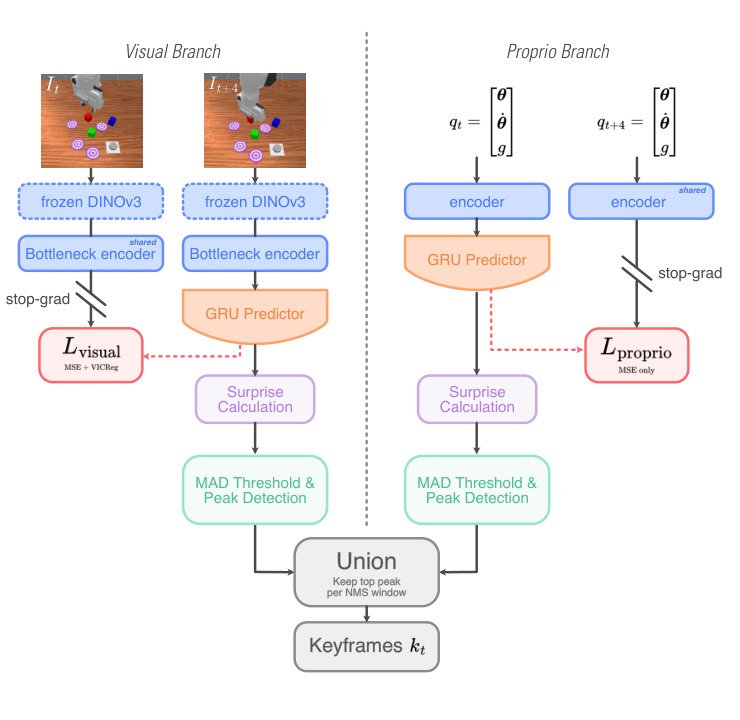
PULSE learns visual and proprioceptive dynamics independently. Vision detects local novelty in a forecast-trained latent space, while proprioception detects unexpected future-state transitions. Each stream is calibrated and thresholded independently, and only the resulting peak lists are fused.

PULSE architecture from the paper, showing independent visual and proprioceptive predictive branches followed by separate surprise detection and peak-list union.
Architecture from the paper: visual and proprioceptive predictive branches are trained independently and fused only after peak detection.

Abstract

Keyframing provides a compact temporal abstraction for long-horizon robot manipulation by retaining only task-relevant transitions from otherwise redundant trajectories. We present PULSE, an online and unsupervised keyframe detector that identifies manipulation boundaries from predictive surprise without boundary supervision or future observations. PULSE learns visual and proprioceptive dynamics independently using two causal predictive branches. Visual surprise is measured as local novelty in a compact forecast-trained latent space, while proprioceptive surprise is measured from future-state prediction error. Each modality is robustly calibrated and thresholded independently, and only the resulting peak lists are fused, allowing either branch to detect events that are salient in one modality but weak in the other.

We evaluate PULSE on manually annotated frame-level boundaries from RoboMME, RMBench, and MIKASA-Robo. The fused detector achieves 0.719, 0.681, and 0.749 F1 at ±10 frames, outperforming every evaluated baseline on all three benchmarks and the average of the top three baselines by 15.4%, 15.4%, and 22.5%, respectively. Task-level analysis further shows that visual surprise is especially effective for environment-driven events with weak kinematic signatures, whereas proprioceptive surprise dominates on contact- and robot-state-driven transitions.
Method

01

Predictive visual representation

A frozen DINOv3 ViT-S/16 produces visual features that are compressed by a learned bottleneck and trained with short-horizon latent forecasting. At inference, the forecast head is discarded and visual surprise is measured as local novelty in the whitened latent trajectory.

02

Proprioceptive prediction error

A causal GRU forecasts the robot state K steps ahead. Surprise is the residual between the state predicted earlier and the state that actually arrives, capturing motion, contact, and robot-state transitions.

03

Frame-rate normalized detection

Temporal detector constants are defined in seconds rather than fixed frame counts: W_win = 2.0 s for visual novelty and NMS = 0.65 s for peak suppression, then converted to frames using the dataset FPS.

04

Late fusion

Visual and proprioceptive signals are robustly calibrated and thresholded separately. Raw scores are never averaged. Only candidate peaks are merged, preserving events that are salient in one modality but absent in the other.

Main Results

PULSE-Union is the strongest method at ±10 frames on RoboMME, RMBench, and MIKASA-Robo.

MethodRoboMMERMBenchMIKASA-Robo
AWE offline0.6710.5620.739
KEMO-style hybrid online0.5850.5640.417
VQ-Memory online0.4100.4220.329
Ours-Proprio online0.6870.6530.690
CoSeg offline0.6130.6450.678
WorthRemembering online0.4980.4680.415
Ours-Visual online0.6670.6410.730
Ours-Union online0.7190.6810.749
0.719
RoboMME F1
0.681
RMBench F1
0.749
MIKASA-Robo F1
22.5%
gain over top-3 baseline mean on MIKASA-Robo

Baseline tuning. AWE, KEMO, VQ-Memory, and CoSeg receive per-task hyperparameter selection on labeled validation episodes. PULSE uses no validation labels for detector tuning: its temporal constants are fixed in seconds and converted using dataset frame rate. On MIKASA-Robo, tuning CoSeg changes F1 from 0.216 to 0.678, while tuning PULSE's suppression window changes 0.749 to 0.755.

Vision Captures Environment-Driven Events

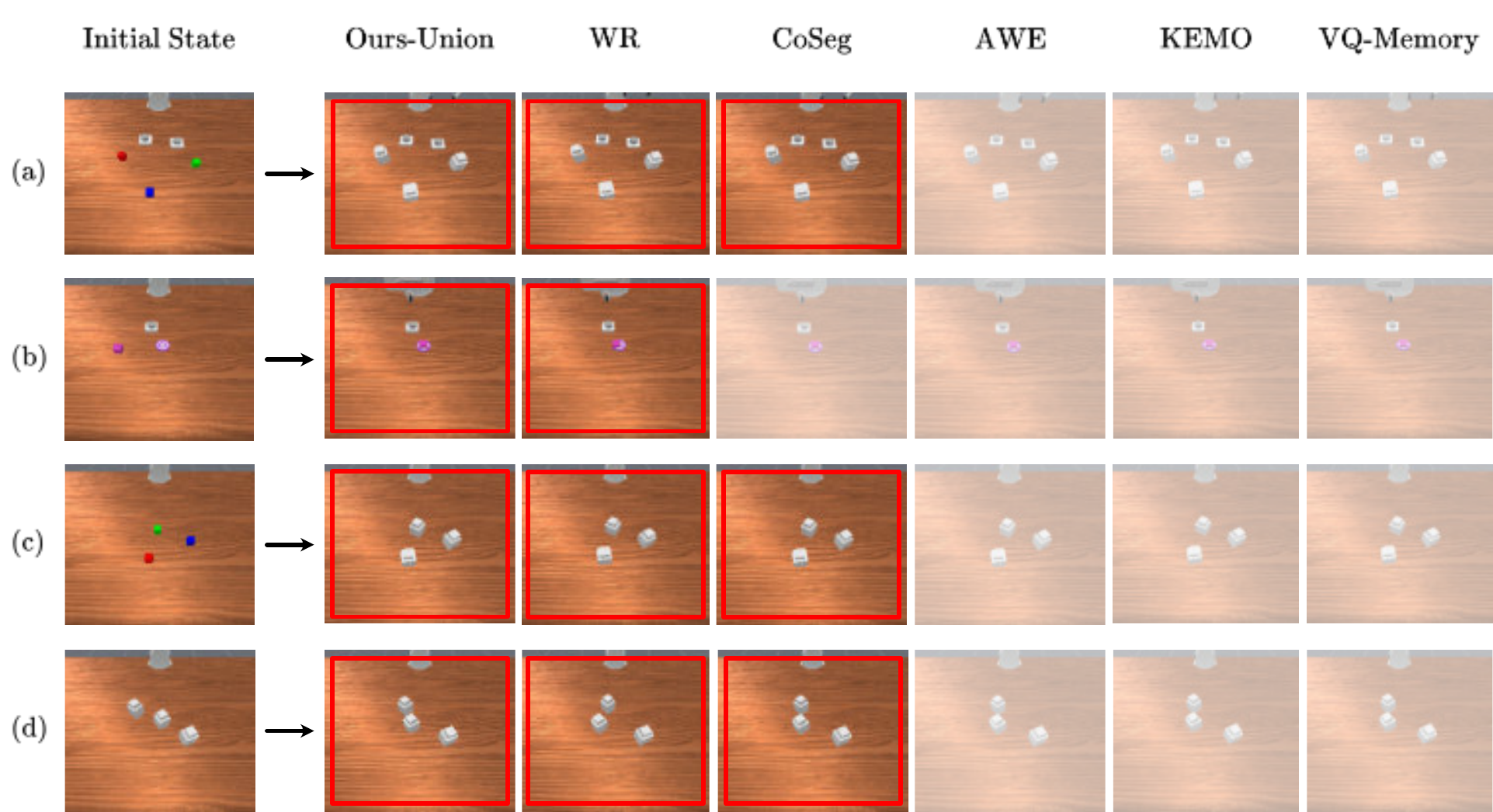
When the scene changes but the manipulator barely moves, conventional kinematic and proprioceptive keyframing can miss the event entirely.

Qualitative comparison on ButtonUnmaskSwap, StopCube, VideoUnmask, and VideoUnmaskSwap.
Representative environment-driven boundaries from (a) ButtonUnmaskSwap, (b) StopCube, (c) VideoUnmask, and (d) VideoUnmaskSwap. Red outlines indicate detections within ±10 frames of the ground-truth boundary; greyed-out frames indicate no detection in that window. Kinematic/proprioceptive methods consistently miss these transitions, while PULSE recovers all four using visual evidence.

Complementary Modalities

Environment-driven

Vision becomes the stronger branch

On the visually driven RoboMME subset, Ours-Visual reaches 0.755 mean F1 versus 0.606 for Ours-Proprio.

Examples include object appearance, unmasking, and scene-state changes with weak robot-motion signatures.

Contact-rich

Proprioception becomes the stronger branch

On the contact-dominant RoboMME subset, Ours-Proprio reaches 0.729 mean F1 versus 0.593 for Ours-Visual.

Examples include insertion, engagement, and transitions primarily expressed through robot state.

Ablations

Surprise formulation

No single event statistic dominates across both modalities. Local novelty is stronger for vision on RoboMME and RMBench, while prediction residual is stronger for proprioception on RoboMME and MIKASA-Robo.

Visual bottleneck

The bottleneck reduces trainable parameters from 17.1M to 4.0M and substantially improves MIKASA-Robo, where the unbottlenecked model over-fires on sparse episodes.

VICReg-style regularization

MSE-only training causes severe variance collapse: 83.9–100% of latent dimensions fall below the variance target, reducing valid surprise peaks and recall.

Conclusion

We presented PULSE, an online and unsupervised keyframe detector for robot manipulation that identifies task-relevant boundaries from predictive surprise in visual and proprioceptive signals. By modeling, calibrating, and thresholding the two modalities independently before fusing only their detected peaks, PULSE preserves events that are salient in one modality but weak in the other. Across RoboMME, RMBench, and MIKASA-Robo, the fused detector achieves 0.719, 0.681, and 0.749 F1 at ±10 frames and outperforms every evaluated baseline. Task-level analysis shows that visual surprise is particularly effective for environment-driven transitions with weak kinematic signatures, while proprioceptive surprise is stronger for contact- and robot-state-driven events.

BibTeX

@inproceedings{pulse2026,
  title     = {PULSE: Surprise-Based Online Unsupervised Keyframe Detection},
  author    = {Anonymous Authors},
  booktitle = {[Workshop], NeurIPS},
  year      = {2026}
}